
PVC Roofing in St. George, UT
PVC Roofing Overview
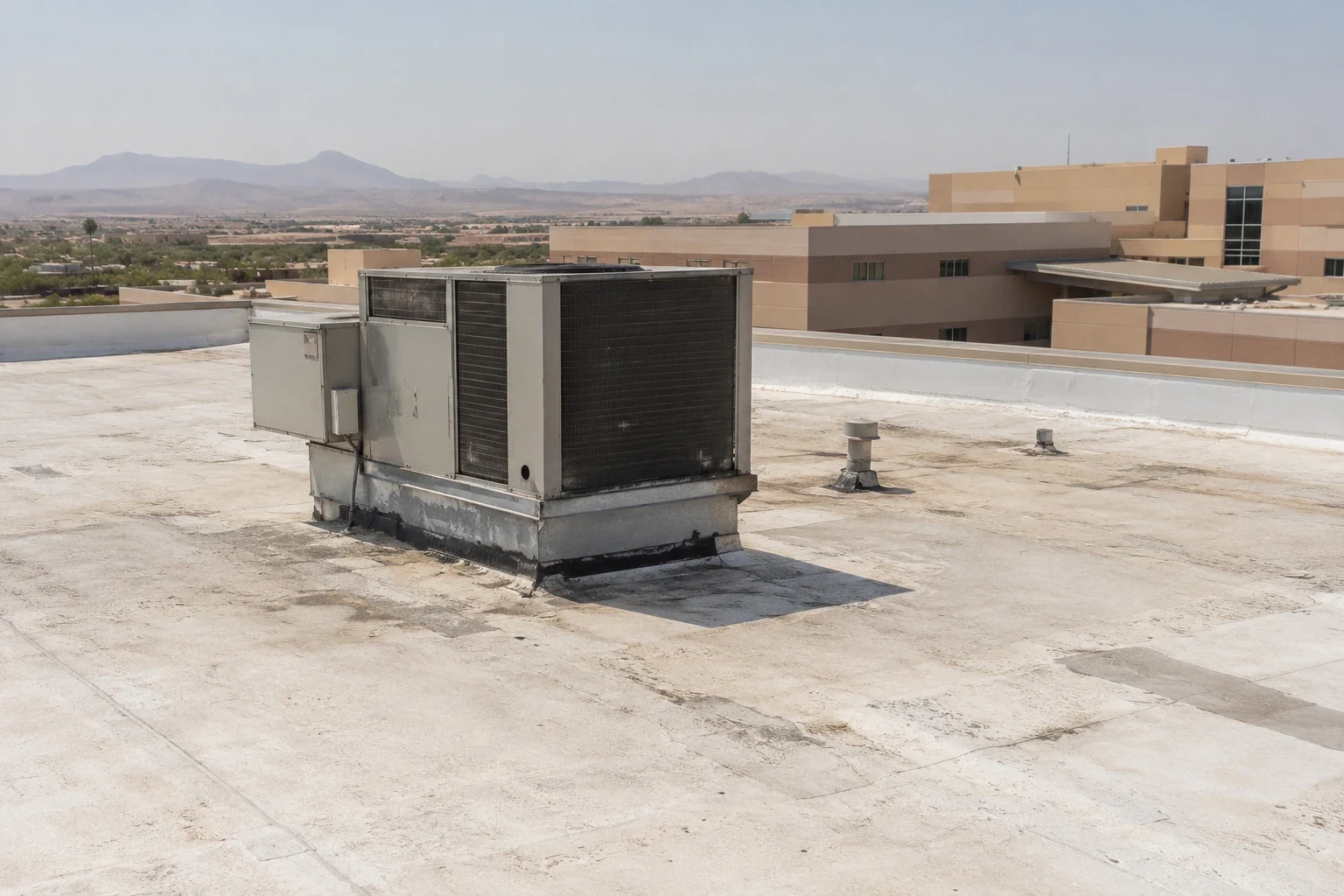
A kitchen exhaust fan can age a roof faster than a St. George summer, and the summer does plenty on its own. Daily highs at the NOAA station hover around 100 degrees across July and August, so a PVC crew plans its welding for the cooler hours and keeps rolled sheet out of the sun. PVC is a single-ply membrane whose seams are fused with hot air, and it is often chosen where grease, oils or process exhaust reach the roof.
That choice only works when the welds are sound, the flashings are the same material as the field and the drains clear. On a visit we check those items first, then ask what is venting onto the roof and where. The asset manager leaves with a repair boundary and a short list of what is still unproven. A commercial roof inspection is the usual first step.

What does a PVC weld need to last?
Clean sheet, even heat and steady pressure. We look along every lap for a continuous bead at the edge, then probe for gaps, skipped stretches and wrinkles that bridge the seam. Dirt, grease film or roofing dust under a weld keeps the two surfaces from fusing, so a seam that looks closed can still peel under a probe.
PVC ages in a way that matters to repairs. Over years the plasticizers that keep the sheet flexible can migrate out, and an old, stiff sheet may not take a new weld. When the age or history is unclear we make a small test weld in a quiet spot, pull it and log the result on the roof plan. That result tells the owner whether a seam repair can run a long way or whether the membrane is near the end of what it can accept.
Summer scheduling follows the same logic. Hot-air welding on a sheet that has been in the sun since sunrise can scorch it, so the crew starts early, shades staged rolls, pulls a test weld at the start of each shift and stops detail work when the surface is too hot to kneel on. A cooler season gives longer working days when the roof is not leaking, and we say so when waiting costs nothing in water risk.
Which exhaust sources put the membrane at risk?
Restaurant hoods, bakery vents, fryer exhaust and some process stacks leave deposits on a roof, and the deposits sit hardest on the sheet downwind of the fan. The Buena Vista Boulevard stretch of Washington City's I-15 and Buena Vista corridor mixes retail, food service, medical, professional-office and lodging uses, and a food-service tenant on a shared roof is the situation where PVC earns its place.
Resistance is not universal. It depends on the membrane formulation and on what is landing on it, so we identify the source, walk the plume path and note whether the sheet shows softening, staining or seam trouble in that zone. A grease tray under the fan outlet and a scheduled wash-down sometimes protect the roof better than a larger repair. Where a vent has moved or a new unit has been added, the deposit zone shifts too, and the roof plan has to follow it.

Why does PVC flashing have to match the field?
Curbs, pipes and wall turn-ups are flashed with PVC-based material welded to the field sheet, and that bond is what keeps the penetration dry. A boot made from the wrong material may look right and still never fuse. We check corners, pre-formed boots and the top edge of each wall flashing, and we look for a channel at the top where water can run behind the sheet. Termination bars get the same look: a rusted bar or a split sealant bead is an early water path.
The same logic governs patches. A patch over an unprepared seam can hide the opening for a season while water finds the next weak point, so the repair has to reach sound sheet and be welded, not just stuck. Rooftop equipment adds its own risk; curb and support details are listed one by one with a photograph so each can be priced and watched.
How do we confirm the drains are doing their job?
February is the wettest month in the station normals at 1.38 inches, and June sits at 0.16 inches, so a PVC roof can sit through a long dry stretch and then meet a storm with drains that are partly packed with grit. We take off strainers, look into the bowl, trace the pipe as far as we can see and check that the overflow is open and set at the right height.
A recover or reroof changes the arithmetic. Added insulation raises the field, a drain bowl that was flush becomes a low pocket, and the new sheet has to be welded to a collar that fits. We measure those heights before the scope is written and, where the old roof held water, build slope with tapered board so the new sheet is not laid over the same ponds. Drain and scupper work goes into the same proposal as the membrane.
How does PVC compare with the other single-ply choices?
PVC and TPO are both heat-welded, but their formulations and chemical resistance differ, so a patch or cleaner chosen for one can damage the other. KEE is a PVC-based sheet made with a ketone ethylene ester modifier for added resistance, and its repair rules follow the manufacturer's data sheet. EPDM is a rubber sheet with a different seam method altogether.
That is why the first job is to identify the sheet in place. Printed markings often wear off, so we take a small sample or read the roof records. A conversion from one system to another needs a transition plan at edges, drains and curbs, and it goes into the scope as a decision with its own price.
When is a PVC roof worth repairing, recovering or replacing?
Repair fits a defect with a clear edge in a sound, bonded sheet. A recover becomes possible when the insulation tests dry, the deck is solid and the added height clears flashings. Wet board, repeated seam failures or a sheet that refuses a test weld point toward a full replacement, and the moisture map settles it.
Fort Pierce Industrial Park, which is largely M-1 in the Guard's armory environmental plan, and the office and retail uses planned at Tech Ridge each put a different load on a membrane: fabrication exhaust on one side, rooftop units and tenant schedules on the other. Whatever the district, send the roof plan, the vent list and the access rules, and we will return a scope that separates what we confirmed from what is still open.
Commercial Roofing Questions
Can PVC be welded to any existing single-ply?
No. PVC fuses to PVC. We identify the installed sheet before choosing a patch or cleaner, and EPDM and TPO need their own materials.
Does PVC resist every kitchen chemical?
Not every one. Resistance depends on the formulation and the substance. We name the source and check the manufacturer's data before we promise a repair.
Why do some PVC seams fail after patching?
Often the weld was laid over grease film or aged sheet. The repair has to be cleaned, tested and welded to material that still fuses.
Can a drain stay when we recover the roof?
Yes, if the bowl, collar and overflow work with the new height. We measure the fit first and price any drain change as its own line.
What would push the decision toward replacement?
Wet insulation across a wide area, a sheet that fails a test weld and seam trouble in several zones. The moisture map and the test welds carry the evidence.