
Roof Warranty Management in St. George, UT
Roof Warranty Management Overview
A repair done on a hot afternoon can cost an owner a warranty. The July normal high at the St. George station is 101.9°F and the August normal 99.9°F, so an adhesive, sealant or seam weld applied in the middle of a summer day may sit outside the manufacturer's installation limits. The warranty holder rarely sees the repair. The manufacturer sees it later, in a claim file, and compares it with the written terms.
Roof warranty management keeps the terms and the work in step. We read the warranty, list its conditions, plan every repair and inspection against them and file the proof. The owner does not need to memorize the document. The file shows what the manufacturer requires, what was done and when, and what remains open. When a leak appears, the first call is to the person named in the file, and the record is already assembled.

What do warranty terms usually ask of an owner?
Terms vary by manufacturer and by the specific warranty, so the first step is to read the one in hand. Common items include prompt notice of a leak, limits on who may repair the roof, rules for adding equipment or penetrations, upkeep of drains and a record of inspections. Some warranties exclude damage from ponding, from foot traffic beyond the walk pads or from chemicals leaving rooftop exhaust.
We summarize those terms in plain language and attach them to the roof plan. Each condition becomes an action: a drain check on a schedule, a notice rule posted for facility staff, a list of approved repair methods. If the terms are unclear, we flag the question for the owner to take to the manufacturer. Only the manufacturer can say what its warranty covers, and the file records its answer.
How are repairs done without voiding coverage?
The repair has to match the manufacturer's published details for the system on the roof. A patch over dirt, a sealant that does not bond to the membrane or a coating over an incompatible surface can release and leave the owner with a larger problem and a disputed claim. We identify the system first, using roof records, labels and test openings where needed, then choose materials and methods compatible with it.
When a warranty limits repairs to certain contractors or requires prior approval, we tell the owner before anything is opened. The owner then decides whether to call the manufacturer first. For an emergency, a temporary dry-in protects the interior without disturbing the roof assembly, and the permanent repair follows once approvals are in place. Our commercial roof repair record shows the product, the method, the weather and the photographs.
Why does St. George heat matter to a warranty?
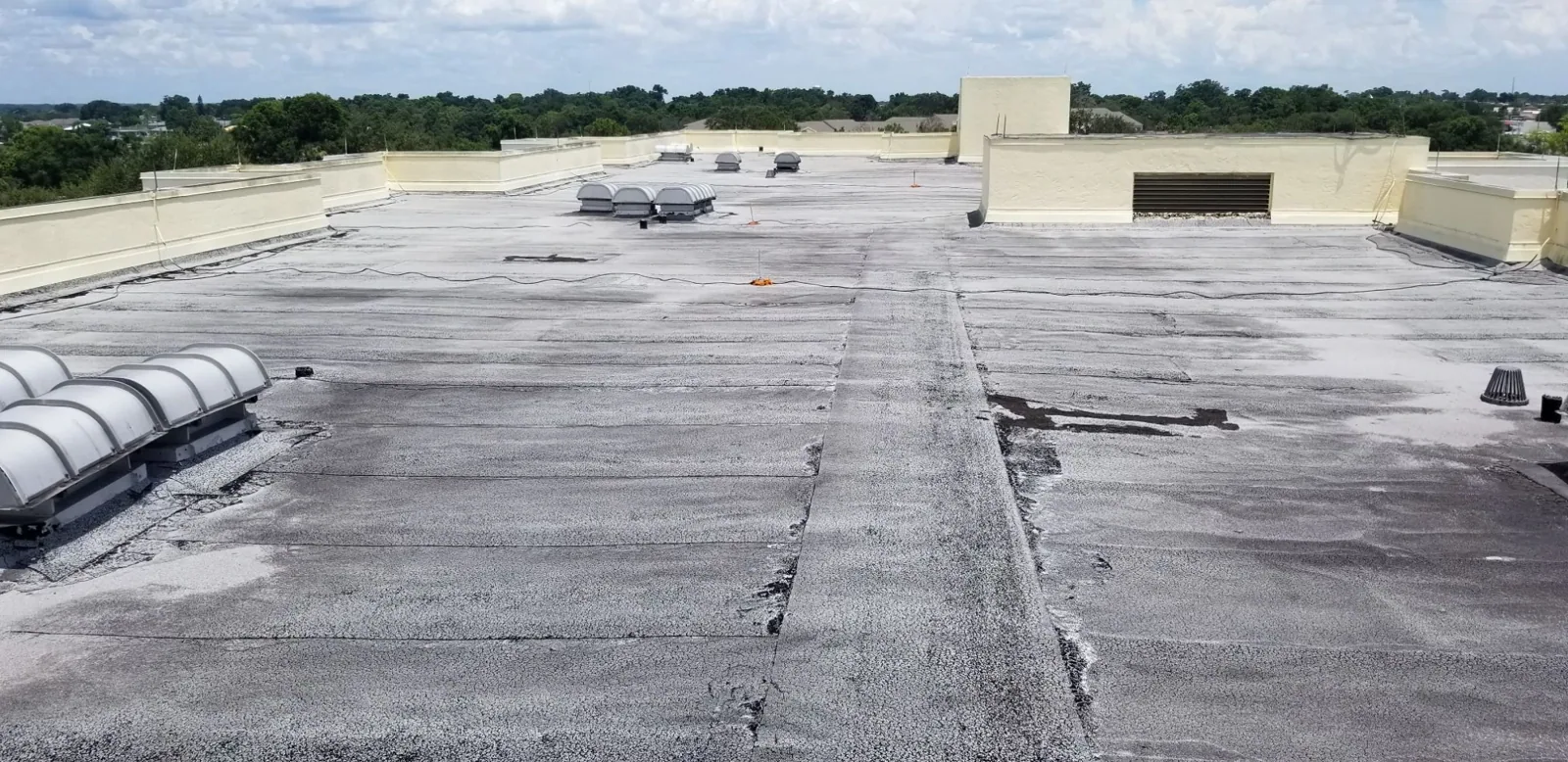
Installation limits include temperature and surface conditions. Adhesives and sealants have working ranges, and a roof at midday in July can sit far beyond them. We treat the station record as a scheduling cue, not a reading for each roof. The crew starts early, checks surface conditions and stops when materials cannot be applied within the manufacturer's range. That discipline protects both the repair and the warranty position. If a day cannot be used, the schedule moves and the owner is told why; a repair that waits one day is cheaper than a repair the manufacturer refuses to recognize.
Heat also drives the wear the warranty will later examine: chalking, shrinkage at edges, open laps and fatigue at flashings. A roof maintained on a schedule shows these signs early, and a repair at that stage is small. A small roof over a street-side suite gets the same upkeep as a large one, with the same photographs, the same dates and the same place in the file. A preventive maintenance plan with dated photographs shows the manufacturer that the owner kept the roof in sound condition, which is usually what a warranty file needs.
What do code and energy rules mean for warranty work?
Two rule sets bear on a replacement here: the 2024 International Building Code as Utah amends it, and the energy side, the 2024 IECC with ASHRAE 90.1-2022, mandatory statewide from July 1, 2026. A reroof or alteration under those rules may require insulation levels or details that interact with the manufacturer's system requirements. If the two differ, the more demanding requirement governs the design.
We confirm the permit-date edition and City of St. George requirements before a replacement or alteration, and we compare them with the manufacturer's assembly requirements. The result goes into the scope, so the installed system satisfies both. When a project crosses the July 2026 date, the file records which pathway applied. A commercial roof replacement scope includes that comparison as a line item.

Which records win a disputed claim?
The ones made at the time. A dated photograph of the roof before work, the product and lot used, the weather during the repair and a signed description of the method make a strong file. Photographs reconstructed from memory do not, and neither do invoices that name a repair without saying where it was made. A line reading "roof repair" proves little; a line naming the roof area, the seam and the date proves a great deal. We keep each record with the roof area it concerns and tie it to the roof plan.
Inspection records matter as much as repair records. An annual or semiannual inspection with photographs shows that drains were cleared and that damage was reported when found. For owners with several buildings, a multi-site roof program keeps the files in one format, which is easier to produce when a manufacturer asks. The asset record holds everything in one place.
Mixed districts raise the stakes. Warehouses, fabricators and wholesalers fit the M-1 land in Fort Pierce Industrial Park, and offices, shops and homes are planned together at Tech Ridge. Buildings across such districts can carry systems from different manufacturers under different warranty terms. One folder per roof, tied to a plan, keeps a Fort Pierce warehouse and a Tech Ridge office from being confused with each other when a claim arrives.
Each file ends with a one-line summary of the next dated obligation.
Commercial Roofing Questions
Does a repair by another contractor void a warranty?
It can, depending on the terms. Some warranties limit who may repair the roof. Read the clause before work starts, and ask the manufacturer in writing if it is unclear.
What should facility staff do when they see a leak?
Report it right away to the person named in the file, photograph the interior stain and avoid tampering with the roof. Many warranties require prompt notice, and a delay can weaken a claim. A one-page contact sheet taped inside the mechanical room door, with the phone number and the first three steps, is the cheapest warranty protection a building can have.
Can rooftop equipment be added without affecting coverage?
Often only with the right details and, in some cases, prior approval. New curbs and penetrations are common leak points. We review the terms and plan the flashing before the unit is set.
Do coatings change a warranty?
They can. Applying a coating may change the original warranty terms or start a new coating warranty. Check with the manufacturer before the work and record the answer.
How long should records be kept?
For as long as the warranty runs and for a reasonable time after, since claims and sales can come later. We recommend keeping them with the roof file for the life of the roof.