
Johns Manville Roofing Systems in St. George, UT
Johns Manville Roofing Systems Overview
On a Johns Manville roof in St. George, UT, the insulation often decides more than the membrane does. The NOAA station averages a July daily high of 101.9°F, and a roof assembly that takes that heat year after year depends on the board under the surface to keep its shape, its R-value and its dryness. A membrane can look sound while the insulation beneath it has compressed, cracked or taken on water. The asset manager's question is which layer governs the next decision.
Johns Manville makes single-ply membranes, built-up and modified bitumen roofing, and polyisocyanurate insulation among other commercial products. We install, repair and maintain these system types. On any roof, we identify the layers, test the insulation and report which element limits the roof's remaining life.
Which layers are on the roof?
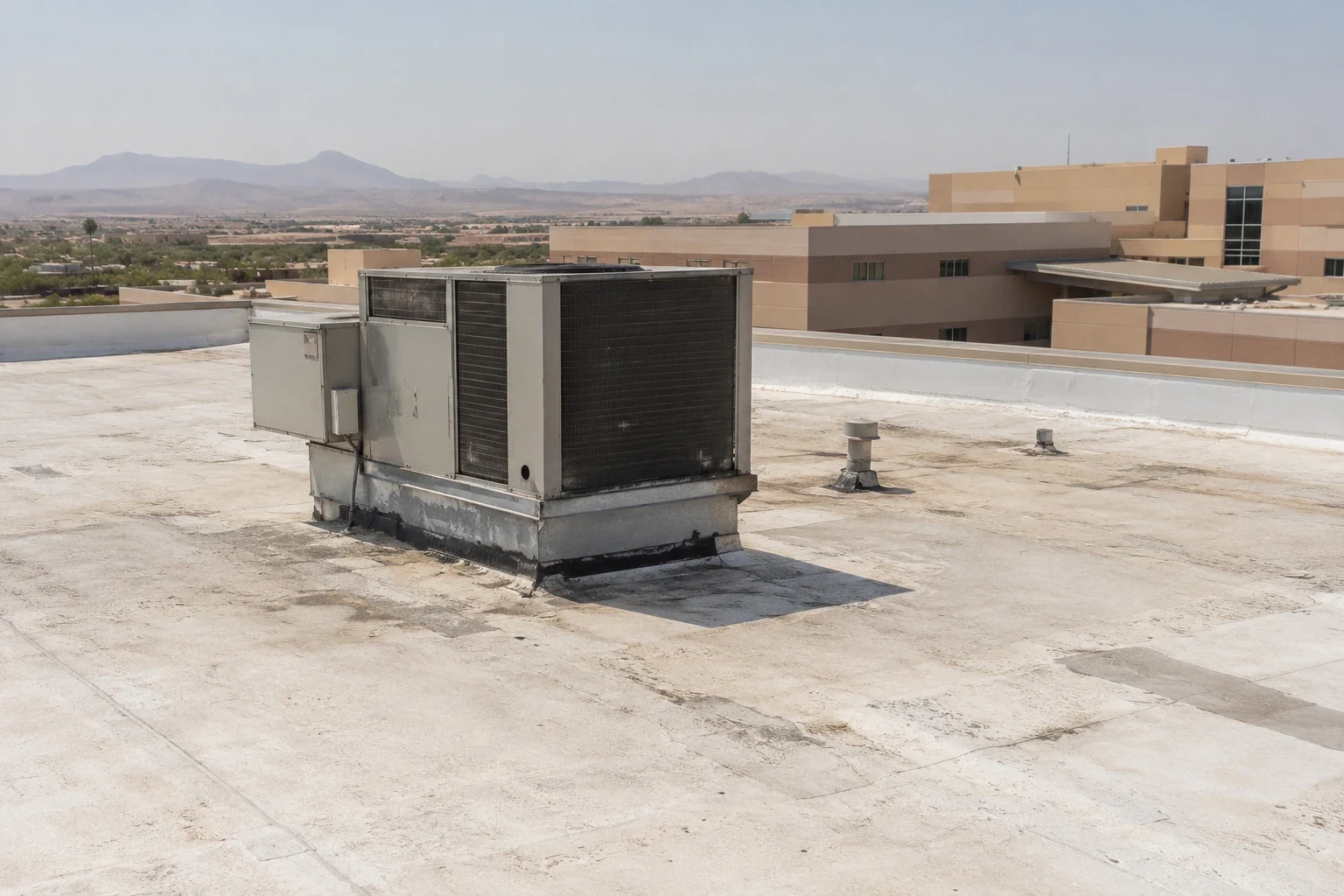
Start from the deck and work up. A typical low-slope assembly has a deck, sometimes a vapor retarder, one or more layers of insulation, a cover board or base sheet and the membrane. Built-up roofs add plies of felt or fabric set in asphalt and finished with a surface layer. Modified bitumen adds reinforced sheets with polymer-modified asphalt. Single-ply adds one sheet, welded or adhered.
We find the layers through edge details, test openings and cores. The roof plan and any original specification help, but the roof itself is the record. A core shows the number of layers, the insulation type and thickness, the condition of each and the presence of moisture. That information drives the choice between repair, recover and replacement. A recover over wet or crushed insulation carries the problem forward, and the core settles whether that risk exists.
Moisture can enter an assembly without a leak. Warm interior air that reaches a cold deck can condense, and a roof without a continuous vapor path control can gather water in winter even though the surface is intact. Condensation can follow a cold night, and cold storage or humid process spaces below make it worse. The core and a look at the interior ceiling tell us whether condensation is part of the story.
What does the insulation tell us?
Polyisocyanurate board is common under low-slope roofs because of its thermal performance per inch. It performs well when dry and protected. Wet board loses insulating value and can break down, and board at a leak can hold water long after the surface is patched. We scan for moisture with infrared testing, mark the suspect areas and confirm with cores.
Thickness matters for the energy code. The commercial energy listing in Utah points to the 2024 IECC and ASHRAE 90.1-2022 and takes effect statewide on July 1, 2026, so a reroof or alteration may need insulation levels set by whichever pathway the project follows. The permit date and scope decide which applies. We confirm with the City of St. George, note the edition in the file and price the board thickness into the insulation and cover board scope. Height changes affect curbs, edges and drains, so the design reviews them together. A thicker board raises the roof surface, which can leave existing curbs too short for proper flashing height and make edge metal too low to catch water at the perimeter. Those changes add cost, and they are cheaper to find on paper than on the roof.
How does heat age built-up and bitumen layers?
Asphalt-based layers soften when the surface is hot and stiffen as it cools. Over years, surfaces oxidize, granules wear and small cracks open at laps and flashings. Gravel or coating on a built-up roof protects the asphalt, and when it migrates or wears away, the underlying layers are exposed to sun. We look for bare spots, blistering, splits at laps and slippage at vertical surfaces.
Precipitation totals 9.31 inches a year at the station, unevenly spread, with February wettest at 1.38 inches. Dry months bake the surface and the first heavy rain finds every split. After a season, we revisit and compare photographs. A built-up roof and a modified bitumen roof show their age in different places, and the comparison tells us whether a coating, a repair or a replacement fits.
How do repairs differ by layer?
A built-up repair removes failed plies back to sound material, dries the area, and rebuilds with compatible felts or fabrics and asphalt or cold adhesive. A modified bitumen repair cuts out the damaged cap sheet, primes the surface and sets a patch with heat or adhesive. A single-ply repair cleans the area and welds or adheres a patch. In all cases, the crew checks for moisture first, because sealing in water makes the patch a trap.
Torch work on a roof carries fire risk, and many owners prefer cold-applied or adhesive methods near combustibles. We discuss the method before work starts, review the building's rules and keep fire watch where the method calls for it. The repair record names the products, the method and the weather. Over time, the series of records shows which areas fail repeatedly and justifies a larger scope.
Fasteners get their own line. Mechanically attached systems rely on screws and plates holding the membrane or insulation to the deck. Pull-out under wind or loosening through thermal cycling shows as ridges or flutter along the lines of fasteners. We check a sample, count what we find and recommend either re-securing or a broader remedy.
Where do these assemblies appear in local buildings?
According to the consolidated plan, much of the residential and commercial stock was built since 1980, and the armory plan puts Fort Pierce Industrial Park largely in M-1, a district of warehouses, light manufacturing and fabrication shops. Tech Ridge describes an office, retail and residential mix on a mesa. These descriptions point to different kinds of buildings, and each may carry any of the assemblies above. We read the roof, not the district. Along the corridors the county maps show, including River Road, the same walk applies to a small suite roof and a large industrial field.
For owners along St. George Boulevard, Bluff Street or River Road, a condition report shows the layers, the moisture and the remaining life of each section. Compare it with the roof plan and the lease obligations before choosing between repair and replacement. Other membrane makers, including Carlisle SynTec and Soprema, appear on neighboring roofs, so identification comes first at every address.
Commercial Roofing Questions
Does wet insulation always mean replacement?
Not always. A small wet area can be cut out and replaced as a section repair. Broad moisture or board that has lost strength points toward replacement. The core and the moisture map decide.
Can an old built-up roof be coated?
Sometimes, if the surface is sound and dry. A coating adds a protective layer but cannot fix splits or wet insulation. We repair first, test, then price the coating against other options.
Why does cover board matter?
It protects insulation from traffic and gives the membrane a firm base. It also helps resist punctures and hail damage. We check it at test openings.
Is torch application allowed on every roof?
No. Building rules, insurance terms and nearby combustibles can rule it out. We review the options with the owner and use adhesive or cold methods when torch work is not suitable.
What if the roof drains are too few?
Add drains or re-pitch with tapered insulation. Standing water adds weight and speeds wear. We measure ponding and propose the fix with the cost, whether that is a cleared outlet, an added drain or a tapered insulation package that moves the water toward the drains it already has.