
Commercial Roofing in Downtown Connected Neighborhood, St. George, UT
Downtown Connected Neighborhood Overview
The city's land-use plan separates the Downtown Connected Neighborhood from the corridor that runs beside it, and the distinction is useful for roof work. A neighborhood designation suggests commercial buildings that may sit close to homes and to quieter streets, where roof jobs are judged by the people next door as well as by the owner. Noise, dust, truck routes and the hour a crew arrives all become part of the scope. We plan for that before a bid, from our base in St. George, UT, and we confirm what each building actually carries overhead on the walk.
A planning label cannot tell us whether a roof is a small low-slope patch of membrane or a larger flat deck with several units. It tells us where to expect close quarters, and we price the job with that in mind.
How do we keep a roofing job from becoming a neighbor problem?
The first step is a written schedule. Start times, lift positions, the dumpster location and the duration of tear-off are shared with the property manager and, where it makes sense, the adjacent owners. We keep material off the sidewalk, protect landscaping and cap the roof at the end of each shift so that a sudden storm does not send water into an open section.
Noise is the second step. Hammer and power-tool work is kept to the middle of the workday where possible, and hot-air welding and fastening are staged so that the loudest tasks do not sit directly over a shared wall. If the crew starts at first light to beat the heat, we tell those who will hear it. A short note delivered the evening before costs nothing and avoids complaints, and it keeps the building on good terms with the people who live and work around it.
Debris control is the third step. We run magnets along the ground for nails and screws, cover the dumpster at day's end and sweep the lot before we leave. Small habits like those are what neighbors remember, long after the membrane is forgotten.
What changes when a roof is small and crowded with equipment?
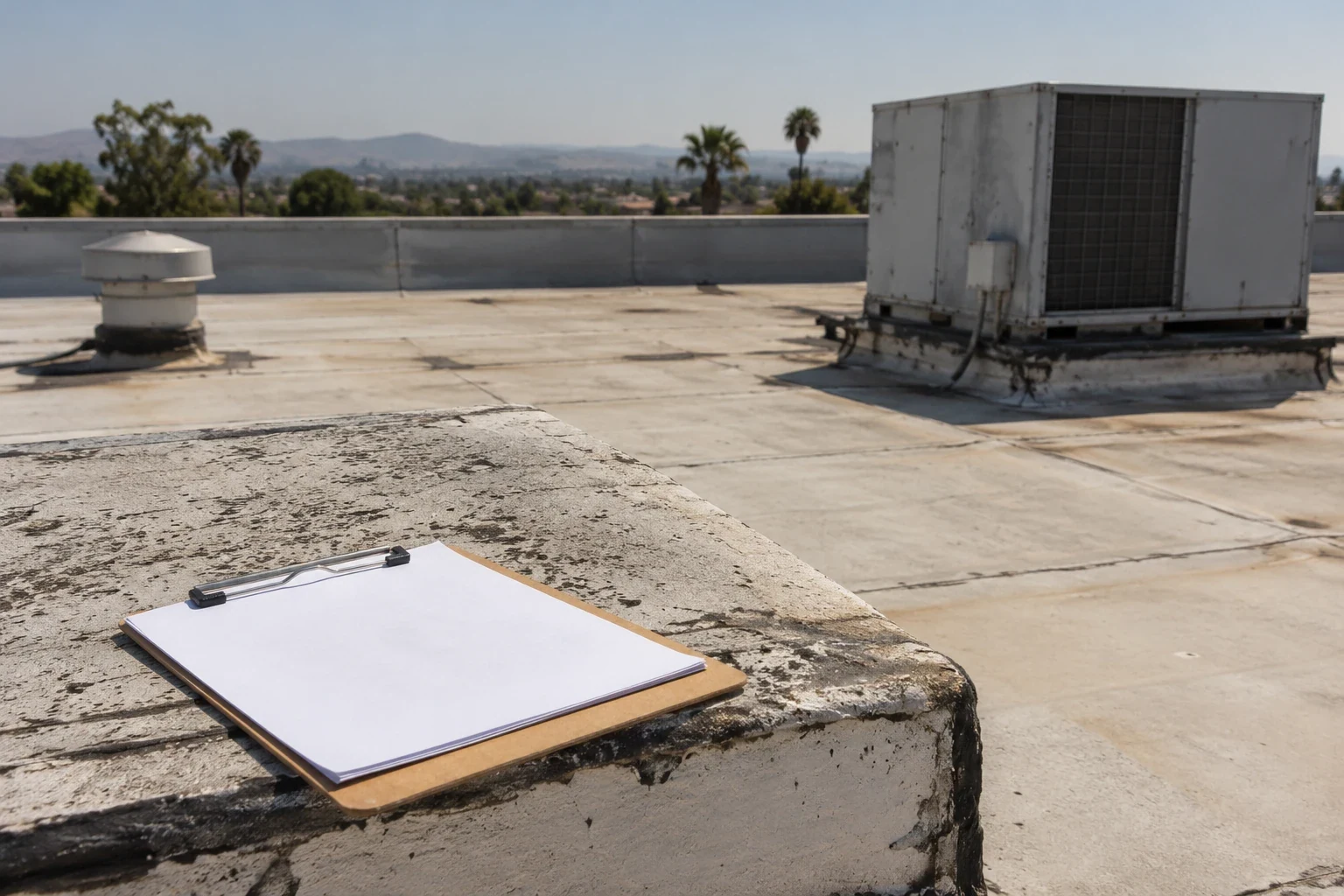
A smaller roof does not mean a simpler one. A modest deck can still carry a rooftop unit, a vent stack, a skylight and a parapet on three sides, and every one of those is a detail that can leak. We map the roof before we touch it, marking each skylight and penetration flashing, the drain and the edge conditions, and we price repair by detail rather than by square foot.
Where the existing membrane is sound but the details are tired, a targeted repair of flashings and seams is often enough. Where the roof has been patched several times, the patches themselves become the leak path, and a full-system answer may be cheaper than the next repair. Moisture evidence from a scan settles the argument by showing how far the wet area extends under the surface.
Drainage on a crowded roof deserves its own note. Added equipment often blocks the old path to a scupper, so water that used to run off now stops behind a curb or a pipe. We trace the flow after a wash-down, mark any new low spot and recommend a small crickets-and-taper fix where it is needed. That is a repair measured in a few hours, and it can end a leak that several earlier patches did not.
How do different tenants change the roof plan?
A dated city analysis lists retail, education and health care, and arts, recreation, accommodation and food service among St. George's largest employment sectors. That list is a baseline for the city and not a tenant roster for this neighborhood, but the sectors illustrate why roofs differ. A clinic wants quiet and steady indoor temperature, a restaurant sends heat and grease upward, and a studio or shop may have skylights or large glazed openings that complicate the roof edge.
We ask each owner what happens under the roof and plan around it. Work above a dining room is scheduled outside meal service, and work above an office is moved off the hours when meetings run. For owners who occupy part of a building and lease the rest, occupied building reroofing is planned section by section so that no tenant carries the whole disruption.
Do the building age and the summer heat change the repair?
The consolidated plan says much of the city's commercial building stock was built since 1980. That is a broad statement, and a downtown neighborhood may hold buildings that were remodeled, extended or reroofed on separate dates. We confirm roof age and overlay history one building at a time and read the cut edge before we name a system.
Heat is the constant. Summer sets the pace: the St. George July normal is 101.9 degrees for the average daily high, August comes in at 99.9, and an unshaded membrane takes that and more. We schedule demanding work for cooler hours and watch for chalking, shrinkage and brittle sealant. A reflective TPO roof can reduce surface temperature, though the choice depends on the deck, the insulation and what is already in place. Where only part of a roof is failing, partial replacement may bring better value than coating the whole. Sections that drain toward a shared wall deserve the first look, since water that finds a way through the flashing there can run along a ceiling to a spot far from the entry point, and that distance is what makes a downtown leak hard to trace without a methodical walk.
What is the next decision after the first walk?
After the walk we deliver photos, a sketch and a short list sorted into repair now, repair soon and watch. An owner can then pick between a repair, a roof coating restoration and a replacement, with the evidence in front of them. The St. George station logs only 9.31 inches of precipitation a year, so the rainy months are few, and the best time to catch a problem is before the wet weeks, when a small fix can still be scheduled in good weather.
Permit rules come first on any reroof, since Utah applies the 2024 International Building Code with amendments, and we confirm what applies before a price is set. Owners who also hold property nearby can ask about the Downtown Connected Corridor and the Lively Downtown area, and we can walk those roofs on the same trip.
Commercial Roofing Questions
Can the roof be worked on without closing the street?
Usually. Most neighborhood jobs use a small lift or hand carry rather than a crane, and we stage in the lot or alley. If a lane or sidewalk must close, we arrange it with the city before the date is set.
Who do we call if a storm opens a section overnight?
Call our emergency line. It runs around the clock, holidays included, and the first visit is a temporary dry-in to protect the interior. A repair scope follows when the roof is dry enough to inspect.
Is a coating a good choice for an older roof?
It can be, if the insulation is dry and the membrane is sound enough to bond a coating. A moisture scan and a test patch tell us. If the roof is wet underneath, a coating would trap the problem.
How do we handle a leak that only shows in heavy rain?
We look at flashing heights, seam condition and drain capacity, because heavy rain finds the weak edge that light rain misses. A water test on a small area often locates the entry point.
What should we send before the first visit?
Send the address, roof drawings if there are any, past repair invoices and the hours of each tenant. Add the access route and whoever holds the roof key.