
Commercial Roofing in Little Valley, St. George, UT
Little Valley Overview
A buyer, lender or owner who asks about a roof wants three answers: what condition it is in, how long it has left and what it will cost to carry. Little Valley appears by name on the city's features map, and Washington Fields Road is one of the arterials the county's road map shows in this part of the region. Those names help us plan a visit from St. George, UT, but they say nothing about the roof over any one tenant or owner.
So we begin with evidence. A walk, a set of photos, a moisture reading where it is warranted and a review of past repairs give the owner a written picture that holds up in a meeting with a lender, a partner or an insurer. The goal is to turn a roof from an unknown line in a budget into a known quantity.

What goes into a roof condition baseline?
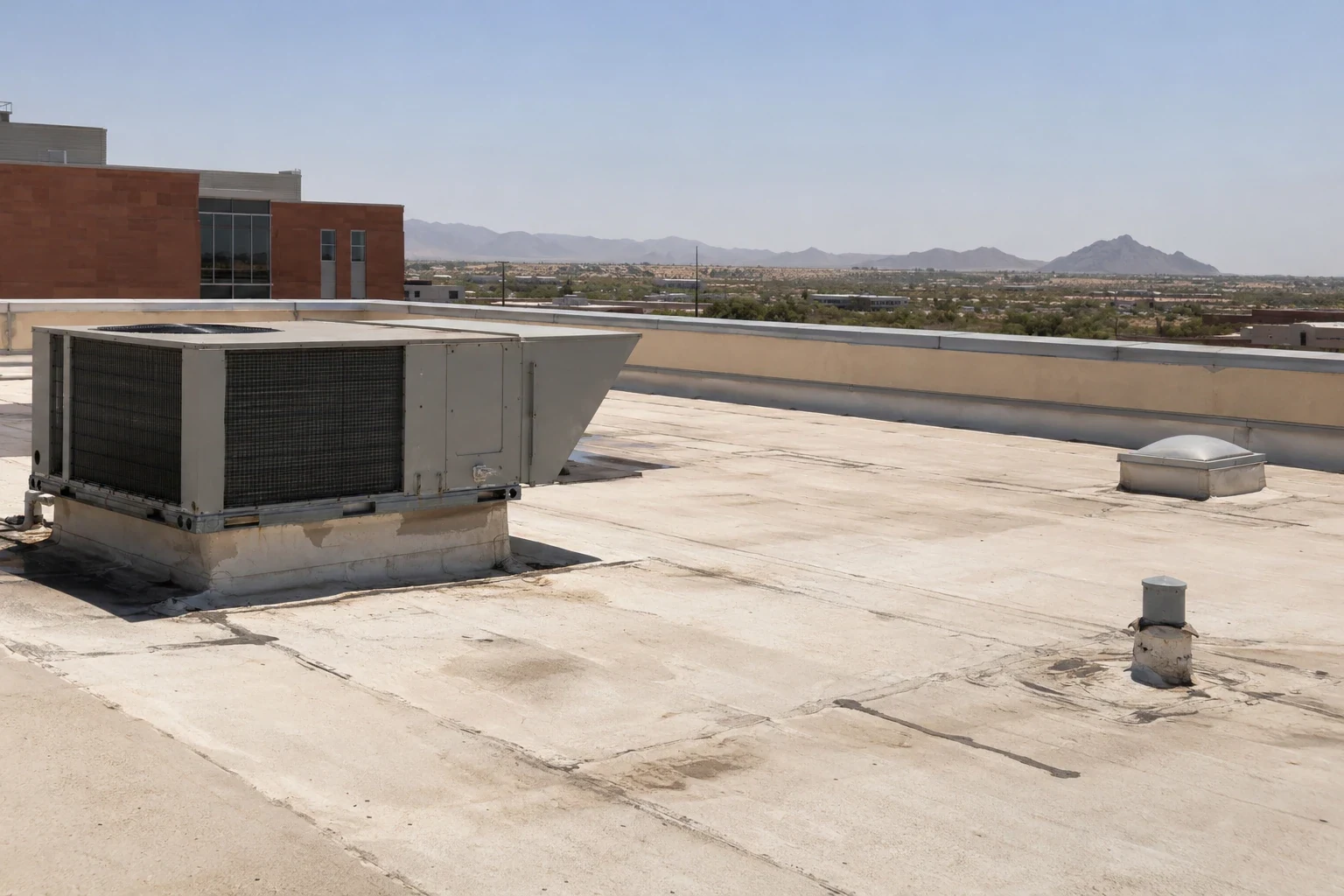
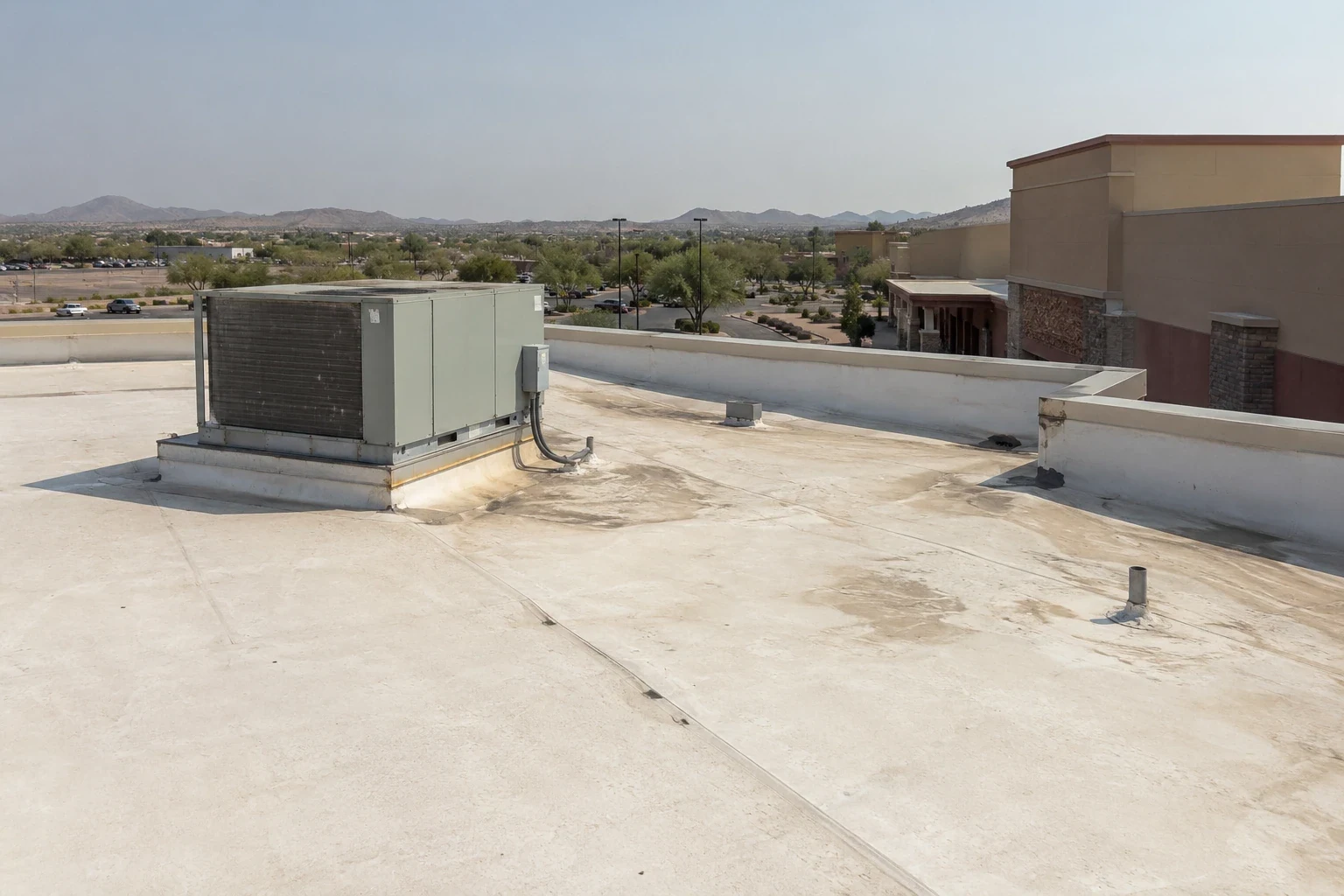
We record the roof in sections. Each section gets a note on the membrane or panel surface, the seams, the flashings, the drains and the penetrations, along with photographs tied to a roof sketch. We probe soft spots, check fasteners, look at the edge metal and measure ponding where water stands. When the owner wants more, we add an infrared scan or a set of core samples to see what the insulation is holding.
The result is a roof condition report that ranks each section as sound, repairable or near the end of life. Because the same format can be repeated every year, an owner sees whether a roof is aging slowly or quickly, and which sections move first. That trend is more useful than any single number, and it feeds directly into the capital budget.
Drainage gets its own row. Rain is rare, with the St. George station logging 9.31 inches in an average year, so a drain that is half blocked can go unnoticed for months. We measure standing water after rain where we can, check the slope toward each drain and note where an overflow path ends. A roof that holds water is aging faster than the same roof that sheds it, and the baseline makes that visible.
How does a roof survey help in a purchase or refinance?
A buyer in the middle of a purchase has limited time and needs an answer that is clear about what is known. We write the survey so that a non-roofer can use it: the immediate repairs, the items to watch and the likely replacement window if the evidence points there. For a portfolio buyer, due diligence roof surveys across several buildings use one format, so the comparison is fair.
Lenders and insurers ask related questions. They want to know whether a roof is near the end of its life, whether a past leak was repaired properly and whether the insulation is dry. We answer with photos and findings, and we keep a clear line between what we saw and what would need testing. A lender reading the file can tell at once which items are confirmed by a probe or a scan and which are visual notes only. Nothing in the report speculates on how an unseen section might look.
Timing matters in a transaction, so we agree on a report date at the start and keep to it. A first call with the buyer's team, a roof walk within the access window and a draft summary before the full report give decision makers what they need as the deadline nears. If the survey turns up an urgent leak, we say so the same day rather than saving it for the final document.
When should a replacement go into the budget?
Replacement timing rests on three things: the condition trend, the cost of repeated repair and the plans for the building. A roof that needs a patch each season, shows wet insulation over a growing area or has failed seams across large fields has stopped being a repair candidate. We lay out the repair path and the replacement path side by side, with cost drivers rather than invented figures, and let the owner see where the lines cross.
Construction since 1980 accounts for much of the commercial stock, per the city's consolidated plan. That is a general statement, so roof age and overlay history are checked for each building here. Where a roof can still be saved, a roof coating restoration may defer replacement; where it cannot, the sooner the capital is planned, the less the owner pays in leak damage while waiting.
How does desert heat enter the lifespan estimate?
Sun and heat shorten the life of many roofing materials. Summer in St. George pushes the average July high to about 102 degrees and August to about 100. A roof surface in direct sun is hotter still, and that exposure dries out asphalt, bakes sealants and drives shrinkage at the edges of single-ply sheets. We assess the surface for chalking, cracking, ridging and loss of granules, and let the findings, not an assumed age, set the estimate.
The same heat limits when we can do the survey itself. Roof walks start early in the day, when the surface is safe to walk and the infrared scan, which depends on temperature difference, can run at dusk. A walk done during the hottest hours would rush the notes and put people at risk, so we do not schedule it then.
Which records make the next decision easier?
Owners can speed up and sharpen the survey by bringing what they have: installation drawings, warranty papers, invoices for past repairs, leak logs and notes from tenants. Even an incomplete set helps us locate old repairs and see what the roof has already been through. Photos from tenants of past stains, even on a phone, can point us to the section that deserves the first look. Statewide energy enforcement for commercial work begins July 1, 2026 under the 2024 IECC and ASHRAE 90.1-2022, so a record of present insulation also helps forecast what a future reroof will need.
For owners with several properties, roof capital planning turns the survey into a ranked list and a multi-year plan. The nearby Bloomington area and Green Valley are on the same service route, so a portfolio that spans several places can be walked on one schedule.
Commercial Roofing Questions
How long does a roof survey take?
Most buildings take a few hours on the roof, plus time to build the report. Larger roofs and add-on scans take longer. We give a timeline when we hear the building size and the deadline.
Do you test for wet insulation?
Yes, when the findings call for it. An infrared scan or a moisture meter shows where insulation holds water, and a core sample confirms it. Those results set the repair boundary and the replacement scope.
What does the report say about remaining life?
It gives a condition rating for each section and a reasoned window based on the evidence. We do not promise a number of years, since leaks, maintenance and weather can shift the picture.
Can the survey happen with tenants in the building?
Yes. Roof walks seldom disturb the interior, and when we need an interior look at a ceiling stain, we arrange it through the manager. Access rules and hours are agreed ahead.
Do you recommend repairs in the same report?
Yes. Each finding comes with a repair option and a cost driver, sorted by urgency, so the owner can fix the urgent items now and plan the rest.