
Roofing for Hotel Owners and Hospitality Groups in St. George, UT
Hotel Owners and Hospitality Groups Overview
A guest who finds water on a ceiling does not blame the weather; the hotel takes the review, the refund and a room out of inventory. Roof work above guest floors therefore has two clocks, the construction schedule and the occupancy calendar. In St. George, UT, both run into summer heat, with the July daily-high normal topping 100 degrees, so early starts and short, sealed work zones are the standard method. The question we ask first is which rooms sit under each roof section and which of those can be taken offline.
The city's older analysis lists accommodation and food services, along with arts, entertainment and recreation, among its large employment sectors, a dated baseline rather than a current ranking. For an owner or an asset manager, it points to what the roof protects: rooms, restaurants, meeting space and pool decks under one parapet line.
Where do hospitality roofs differ from other commercial roofs?
A hotel roof is a collection of uses. There may be a low-slope field over guest floors, a pitched or screened mechanical area, a roof over the kitchen and laundry, a flat roof over a lobby or ballroom and a terrace or pool deck that is part of the guest experience. Each has a different membrane stress and a different consequence when it fails. Laundry and kitchen exhaust, rooftop HVAC units and stairwell bulkheads add curbs and penetrations to the mix.
Lodging is one of the uses Washington City lists along its Buena Vista Boulevard stretch, next to retail, food service, medical and professional office, which shows how a hotel sits among neighbors. On a corridor like that, a lodging site may sit beside a restaurant or a store. For the mechanical and curb detail on a hotel roof, we map each equipment cluster and its flashing separately from the field.
How do you keep rooms sold while the roof is open?
We plan with the front desk, not around it. The general manager identifies the rooms under each zone, the dates when they can be blocked and the quiet hours for guests. Work that makes noise, such as tear-off and fastening, is scheduled for the hours the hotel selects, and the crew avoids the zones above rooms that are sold on those dates.
Staging gets the same attention. Guest parking, valet routes, loading docks and porte-cochere clearances decide where a lift or a material hoist can stand. Occupied-building reroofing divides the roof so each zone is dried in daily, and the hotel receives a short written plan with dates by wing. If a room is affected, the manager decides whether to hold it, and the crew does not enter a guest room without a staff escort.
What does the top floor tell you about the roof?
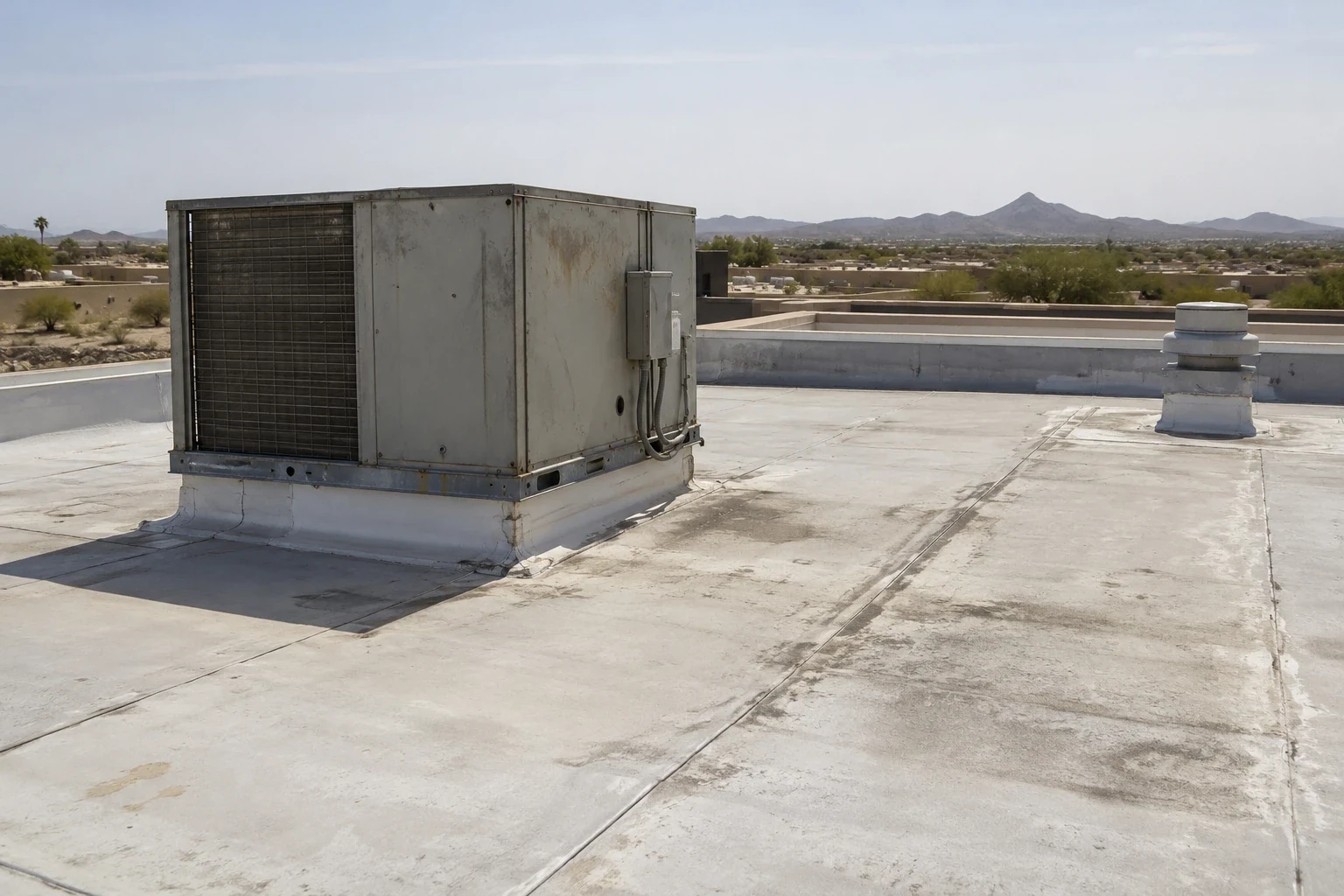
Interior stains on a top-floor ceiling, a musty smell or a patch of loose paint are the early report. Housekeeping and engineering usually see them before the roof does. We ask for those observations by room number, then trace upward through the wall and ceiling path to the roof element above, which may be a drain, a parapet, a rooftop unit curb or a seam. Water can travel along a deck and drop in a different room, so the room is a clue and not an address. We record the sequence of reports, since a stain that returns after each rain tells a different story from one that appears once after a pipe event, and we flag the plumbing and HVAC condensate lines that sometimes cause the stain instead of the roof.
Hotels with low-slope sections need strong drainage. The station normal is 9.31 inches of precipitation a year, with its high point in February, so a roof can pass the summer unchallenged and then meet a heavy winter storm. We check drains and scuppers, parapet caps and wall flashing before the wetter months, and photograph each top-floor risk area for the maintenance file.
Is the roof ready for another season or does it need a plan?
A hotel that is sound but showing wear can be coated or repaired to extend service, and roof coating restoration is a candidate where the substrate is dry and the membrane is intact. A roof with repeated leaks, saturated insulation or a deck concern is not. We give the owner both paths with a plain statement of what each requires.
Surface reflectance also matters in a hot market. A cool roof surface reduces heat gain at the roof, but it cannot repair a failing assembly, so the plan treats it as an upgrade to a sound roof. Where a hotel is planning a renovation, the roof scope should be timed with it, so that new rooftop equipment is not set on a membrane that will be replaced a year later.
How does the roof fit a hotel capital plan?
Brands set property improvement cycles, and owners schedule major work around them. We give the owner a condition record by roof section, probable actions with timing ranges, and the cost drivers: tear-off layers, insulation, equipment lifts, access restrictions and the number of weeks rooms must be blocked. The cost of blocked rooms is the owner's figure, not ours, but the plan identifies how many zones and how many weeks of access are needed. Phasing the work by wing, and placing the heaviest tear-off in the slowest stretch of the owner's calendar, usually does more to protect revenue than any change in roofing method.
Code enters at the permit date. Under Utah's amended 2024 International Building Code, with energy-code enforcement beginning statewide on July 1, 2026, the permit date will decide the insulation and edge requirements. A roof capital plan collects those open items beside the schedule. Owners who hold hotels through a fund can pass the same record to the investor or REIT that reviews the capital budget.
What should the general manager or owner send first?
Send the property list, the rooms under each roof section if known, the occupancy calendar with the weeks that cannot be interrupted, existing roof drawings and warranties, and the leak history by room. Add the engineering contact who controls roof access and the brand standards that apply to exterior work.
Properties near the Santa Clara Gateway, which the city's plan describes as having regional highway access at a major intersection, may have different traffic and delivery patterns from those on Buena Vista. A group that also runs dining shares kitchen-exhaust concerns with restaurant and retail brands and can use the same roof list for both.
Commercial Roofing Questions
Can the crew work above occupied rooms?
Yes, if the hotel agrees. Quiet hours, room blocks and escorts are set with the general manager, and we avoid noisy tasks above rooms sold for those dates.
How do you handle a leak into a guest room?
We respond at any hour and stop water entry first. The hotel decides what happens to the room, and we record the roof source so the repair addresses it.
What if the pool deck or terrace is on the roof?
Deck areas have waterproofing beneath the surface. We coordinate with the pool or paver contractor, since the membrane may be under the finish and repair may require removing part of it.
Will roof work affect brand inspections?
It can. We share the work schedule and completion records so the property can show the status of the roof when a brand representative visits.
How do you keep noise down?
By scheduling noisy tasks away from sold rooms, using the quietest method that fits the roof, and stopping at a time the hotel names. Tear-off is the noisiest part and is placed carefully.